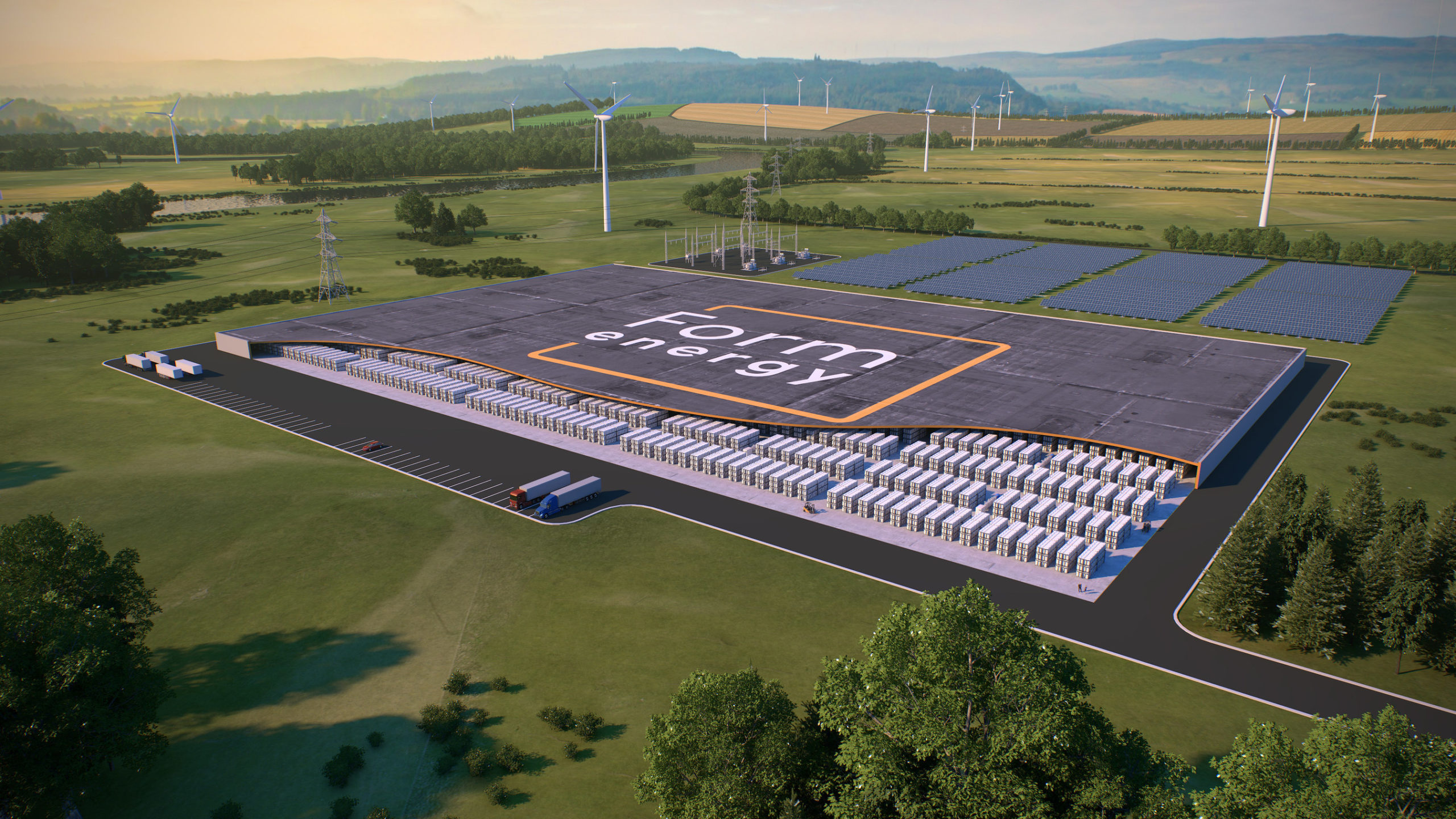
Photo: Form Energy
The iron-air battery — once a forgotten technology from the 1960s — is now the most compelling story in long-duration energy storage (LDES). In just 18 months, it has moved from a pilot project in a Dutch university lab to multi-gigawatt supply agreements with some of the world’s largest technology companies and utilities.
This article traces that journey: from Ore Energy’s world-first grid-connected system in Delft, to Form Energy’s 30GWh Google-Xcel deal, to the 12GWh Crusoe agreement announced at CERAWeek 2026. Together, these milestones confirm that iron-air batteries are no longer a future concept — they are a present reality.
Ore Energy: The European Pioneer
In July 2025, the Netherlands-based startup Ore Energy achieved what no company had done before: it connected the world’s first iron-air battery system to the electric grid. Deployed at TU Delft’s Green Village, the pilot system demonstrated that iron-air chemistry — based on reversible rusting — could reliably store energy for up to 100 hours using abundant, locally sourced materials.
For Ore Energy, the milestone was about more than technology. It was a statement of European energy sovereignty. The entire system was designed, built, and installed within the European Union, using a fully local supply chain. Co-founder and CEO Aytaç Yilmaz described it at the time as “proof that Europe can lead the world in energy innovation and resilience.”
Form Energy: Scaling for the US Market
While Ore Energy was making history in Europe, its US counterpart Form Energy was rapidly scaling production. Form emerged from stealth in 2021 with a bold claim: its iron-air battery could deliver 100-hour duration at a cost of less than $20/kWh — roughly one-tenth the cost of lithium-ion.
By 2025, Form had operationalised its commercial-scale factory, Form 1, in Weirton, West Virginia, on the site of a former steel mill. The factory began fulfilling orders from major utilities including Xcel Energy and Georgia Power, with first projects scheduled to come online in late 2025 and 2026.
Google Enters the Stage: 30GWh with Xcel Energy
The turning point for iron-air’s commercial credibility came in February 2026. Google announced a landmark agreement with Xcel Energy to deploy Form Energy’s iron-air batteries as part of a massive clean energy system for a data center campus in Minnesota.
The project’s scale was staggering: 1.9GW of renewable generation paired with 300MW / 30GWh of iron-air storage — the largest energy storage project ever announced in terms of watt-hour capacity. For Google, the 100-hour duration of iron-air batteries solved a critical problem: how to keep data centers running through multi-day lulls in wind and solar generation.
Crusoe’s 12GWh Deal: AI Infrastructure Goes LDES
Just weeks later, at CERAWeek 2026 in Houston, Form Energy announced another major agreement. Crusoe, an AI data center developer focused on “energy-first” infrastructure, signed a 12GWh supply agreement for iron-air batteries, with delivery scheduled to begin in 2027.
Crusoe’s business model — securing power capacity alongside GPU computing — aligns perfectly with the emerging “bring your own power” (BYOP) trend encouraged by US policymakers. By deploying iron-air batteries, Crusoe can bypass congested grid interconnection queues and deliver reliable, low-carbon power to its data centers.
Notably, the Crusoe deal followed the 30GWh Google-Xcel announcement by less than a month, demonstrating that momentum for iron-air technology is accelerating rapidly.
Why Iron-Air Now?
Three factors explain the sudden commercial takeoff of iron-air batteries:
Duration matters. Lithium-ion batteries typically provide 4 to 8 hours of storage — enough for daily peaks but insufficient for multi-day renewable lulls. Iron-air’s 100-hour capability enables true renewables firming.
Cost wins. At under $20/kWh, iron-air is an order of magnitude cheaper than lithium-ion for long-duration applications. Utilities can store large amounts of energy without straining grid finances.
Supply chain security. Iron-air batteries use iron, water, and air — no lithium, cobalt, or rare earths. This aligns with growing regulatory pressure (EU Critical Raw Materials Act, US domestic content requirements) to reduce dependence on foreign-controlled supply chains.
What’s Next for Iron-Air?
With 42GWh of announced orders in early 2026 alone, iron-air is moving from demonstration to mass deployment. Form Energy is targeting 50GWh/year of production capacity by 2030. Ore Energy has set similar ambitions for the European market.
For grid operators, utilities, and data center developers, iron-air offers a clear path to reliable, affordable, and truly clean energy. As Mateo Jaramillo, Form Energy’s CEO, put it: “This is not just innovative — it is potentially transformative for the sector.”
Further Reading
For more insights on long-duration energy storage technologies, policy frameworks, and market trends, visit LDESgrid.com — the brand gateway for grid decarbonization.