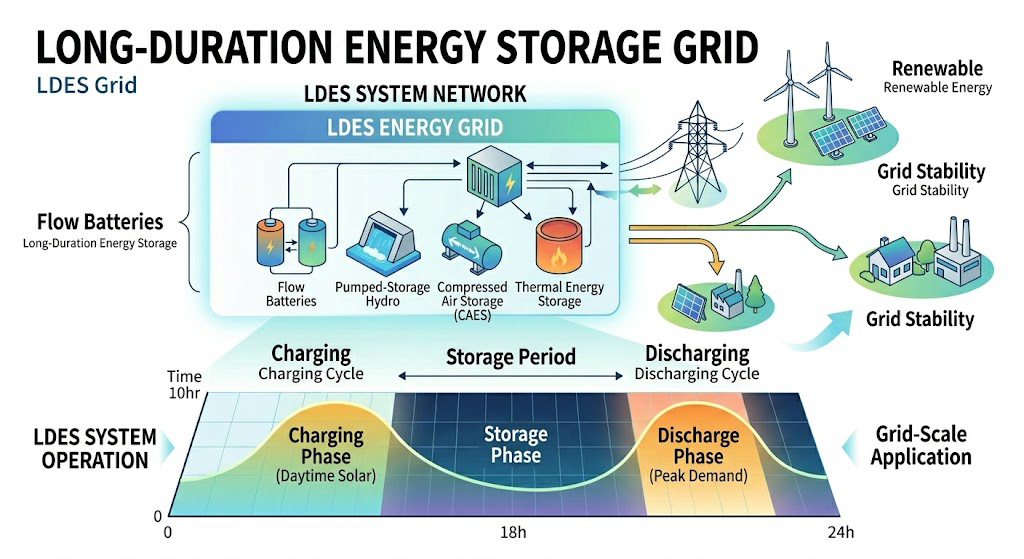
The United Kingdom is on the cusp of creating one of the world’s first dedicated revenue support mechanisms for long-duration energy storage (LDES). If designed well, it could unlock billions of pounds of investment in iron-air, zinc-air, flow batteries, and other technologies capable of storing clean energy for 10 hours or more.
This article provides a clear overview of where the policy stands, what’s being proposed, and why it matters for project developers, utilities, and investors watching the UK market.
Background: Why LDES Needs a Specific Policy
LDES technologies face a classic “first-of-a-kind” challenge: they are capital-intensive, have long development timelines, and compete against mature alternatives (gas peakers and lithium-ion) whose costs do not yet reflect the full value of multi-day flexibility.
In response, the UK government and energy regulator Ofgem have been working since 2024 on a market mechanism specifically designed to support LDES. The goal is to provide revenue certainty that enables projects to reach financial close, while ensuring value for money for consumers.
Current Status: Consultation and Timeline
In March 2026, Ofgem published a consultation on the proposed LDES revenue support framework. The document sets out detailed options for a cap-and-floor model — a mechanism already used for electricity interconnectors and some electricity storage projects.
Key dates to watch:
March – May 2026: Industry consultation period
Summer 2026: Ofgem expected to launch a formal consultation on final proposals
Early 2027: First LDES projects expected to enter the scheme
How the Cap-and-Floor Model Works
Under a cap-and-floor mechanism, the government (through Ofgem) provides a revenue floor that guarantees a minimum income for eligible LDES projects. If market revenues fall below the floor, the scheme makes up the difference. If revenues exceed a pre-agreed cap, the excess is shared with consumers.
This structure is designed to:
Reduce investment risk – developers can secure financing with greater confidence
Protect consumers – the cap ensures that any windfall gains are returned
Enable project bankability – lenders value the certainty of a regulated revenue floor
What Technologies Are Eligible?
The March 2026 consultation proposes a technology-neutral approach. Eligible projects must meet a minimum duration threshold — currently proposed at 8 hours or more, though the final duration requirement is still under discussion. This would include iron-air, zinc-air, flow batteries, compressed air storage (CAES), and some hydrogen storage configurations.
Ofgem has also indicated that projects should be grid-scale (typically over 50MW) and connected to the transmission or distribution network. A phased approach is likely, with initial rounds focusing on proven technologies before expanding to more novel systems.
Why This Mechanism Matters
The UK’s approach is being watched closely by policymakers in Europe and beyond. If successful, it could become a template for other markets designing LDES support schemes. For investors, the mechanism offers a clear signal that the UK is serious about LDES as a pillar of its Clean Power 2030 ambition — which targets 4–6GW of LDES capacity by the end of the decade.
For project developers, the consultation provides a tangible timeline. Companies like Highview Power (liquid air storage), Invinity (vanadium flow), and international players such as Form Energy (iron-air) are already positioning themselves for the UK market.
What’s Still to Be Decided?
Several key questions remain open in the current consultation:
Duration threshold: Should the minimum be 8 hours, 10 hours, or higher?
Project size: Should there be a lower MW limit to focus on truly grid-scale assets?
Technology eligibility: How to treat hybrid systems (e.g., hydrogen with storage)?
Allocation method: Will there be competitive auctions, or will projects be selected administratively?
Stakeholders have until May 2026 to submit responses. The final design will likely emerge over the summer, with first projects entering the scheme in 2027.
Implications for the LDES Sector
A well-designed revenue support mechanism would significantly accelerate LDES deployment in the UK. It would:
Reduce the cost of capital for early projects
Enable supply chain investments (factories, installation capacity)
Signal long-term commitment to LDES as a system-critical technology
Create a reference case for other European markets designing similar mechanisms
Further Reading
For ongoing coverage of UK and European LDES policy, market developments, and technology trends, visit LDESgrid.com — the brand gateway for grid decarbonization.
This article will be updated as Ofgem releases its final proposals in mid-2026.