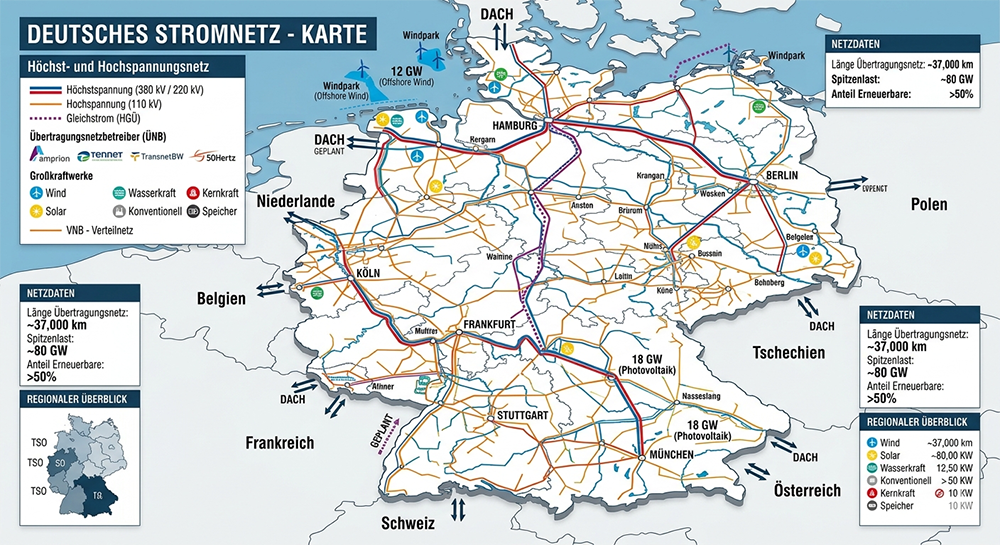
Germany is preparing to launch one of Europe’s most ambitious energy market reforms: a comprehensive, technology-neutral capacity market scheduled to go live in 2027. The move, agreed between the German government and the European Commission in January 2026, will fundamentally reshape how grid-scale storage, flexible generation, and demand-side resources are compensated.
For long-duration energy storage (LDES) technologies — including iron-air, zinc-air, and flow batteries — the new capacity market represents a massive opportunity. It creates a predictable revenue stream for assets that can deliver reliable power during periods of grid stress, aligning market incentives with system needs.
Why a Capacity Market Now?
Germany is retiring its coal and nuclear fleet while rapidly expanding renewables. By 2030, the country aims for 80% renewable electricity. But as weather-dependent generation grows, so does the need for dispatchable capacity to cover multi-day lulls in wind and solar output.
Germany’s existing electricity market (an “energy-only” market) compensates generators only for the power they actually produce. That works well for conventional plants but does not adequately reward assets that stand ready to supply power when needed — especially long-duration storage that may only discharge a few times a year.
The new capacity market fixes this by paying participants for their availability, not just their output. This creates a stable revenue foundation for LDES projects that are capital-intensive but have low operating costs.
Timeline and Key Milestones
The capacity market is being developed through a structured process:
January 2026: Germany secures European Commission approval for the capacity market framework, clearing the way for implementation
2026 (ongoing): Detailed market rules, product definitions, and auction designs are being developed by Germany’s Federal Network Agency (BNetzA)
2027: First capacity market auctions expected to launch, with contracts covering delivery years starting in 2028–2029
How the Capacity Market Will Work
While final details are still being finalized, the framework is expected to include:
Technology neutrality: All resources that can provide reliable capacity — including LDES, hydrogen-ready gas plants, demand response, and interconnectors — will be eligible
Duration requirements: Capacity providers will need to demonstrate they can deliver power for a defined period (likely 4 to 8 hours minimum, with longer durations potentially rewarded with higher availability factors)
Competitive auctions: Capacity will be procured through competitive auctions to ensure cost efficiency
Regional differentiation: Auctions may be segmented by region to address local grid constraints, particularly in southern Germany where thermal plant retirements are concentrated
What It Means for LDES
For long-duration storage developers, the capacity market is transformative for several reasons:
Revenue certainty: LDES projects can secure stable, multi-year contracts that make financing viable
Fair valuation: The market recognizes the full value of multi-day duration, which the energy-only market undervalues
Scaling signal: A clear policy framework encourages supply chain investments in manufacturing and installation capacity
Companies already active in Germany include Form Energy (iron-air), which has expressed interest in the European market, and Fluence and NGEN, which are developing LDES projects across the country. Zinc-air developers such as Zinc8 Energy Solutions and E-Zinc are also watching closely, as their medium-duration profile (8–24 hours) fits well within the capacity market’s likely duration requirements.
Germany in the European Context
Germany’s capacity market will be one of the largest in Europe, alongside France’s and Poland’s. But its design matters beyond its borders. As Europe’s largest economy and power market, Germany’s approach is likely to influence neighboring countries and the EU-level electricity market reform debate.
For investors, the capacity market adds to an already supportive German policy landscape that includes:
Simplified permitting: Since December 2025, large battery storage systems enjoy privileged status under Federal Building Code, streamlining approval
Grid access reform: New “maturity-first” interconnection rules prioritize projects most valuable to the system
Hydrogen-ready mandates: New gas plants must be hydrogen-ready, creating synergy with storage technologies
What’s Still to Be Decided?
Several key questions will be resolved in the coming months:
Duration specification: Will the capacity market include explicit bonuses for longer-duration assets?
Storage treatment: How will the market account for the fact that storage is an energy-limited resource (unlike a power plant)?
Stacking rules: Can capacity market revenues be stacked with other revenues (e.g., energy arbitrage, grid services)?
Cross-border participation: Will foreign LDES assets be eligible to participate?
Looking Ahead
With first auctions scheduled for 2027, project developers have a clear runway. The capacity market, combined with Germany’s broader energy transition targets, creates a compelling investment case for LDES. Analysts estimate that the market could support several gigawatts of new long-duration storage capacity by the early 2030s.
For utilities, infrastructure funds, and technology companies, now is the time to position for Germany’s capacity market — both in terms of project development and digital brand presence.
Further Reading
For ongoing coverage of German and European LDES policy, market developments, and technology trends, visit LDESgrid.com — the brand gateway for grid decarbonization.
This article will be updated as the Federal Network Agency releases detailed capacity market rules through 2026.