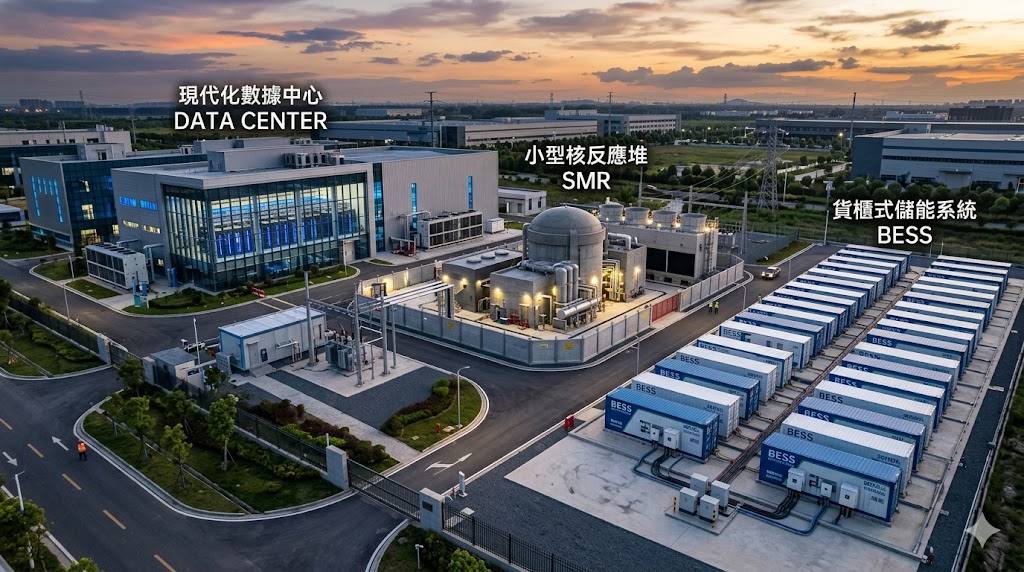
As the global race for Artificial Intelligence (AI) dominance accelerates, a silent but fierce bottleneck has emerged: reliable, carbon-free baseload power.
In 2026, tech giants like Google, Microsoft, and Amazon are no longer just software companies — they have become the world's most aggressive energy infrastructure investors. To achieve a "24/7 Carbon-Free Energy" (CFE) goal, the industry is moving toward a strategic "Power Quad" consisting of Small Modular Reactors (SMRs), the critical HALEU fuel chain, and Long-Duration Energy Storage (LDES).
1. SMR: The Uninterruptible Heart of AI Data Centers
Traditional renewable sources like wind and solar are intermittent by nature. However, AI workloads require constant, high-density power. Small Modular Reactors (SMRs) are the solution. Unlike traditional massive nuclear plants, SMRs are factory-built, scalable, and can be co-located directly with data center campuses.
By providing a steady "baseload," SMRs eliminate the reliance on fossil-fuel peaker plants, ensuring that the "brains" of AI never go dark.
2. HALEU: The Fuel Bottleneck
You cannot have the SMR revolution without the fuel to power it. Most advanced SMR designs require High-Assay Low-Enriched Uranium (HALEU). Currently, the global supply of HALEU is extremely constrained.
Securing the HALEU supply chain has become a matter of national energy sovereignty and corporate survival. Companies that control HALEU enrichment and logistics will hold the keys to the next generation of nuclear energy. Without a robust HALEU infrastructure, the ambitious SMR timelines of the late 2020s simply cannot be met.
3. LDES: The Grid's Essential Shock Absorber
While SMRs provide constant power, the grid still faces variability from renewables and sudden spikes in AI processing demand. This is where Long-Duration Energy Storage (LDES), such as iron-air and zinc-air batteries, becomes indispensable.
Unlike lithium-ion batteries that discharge in 4 hours, LDES systems (targeting 100+ hours) act as the grid's "shock absorber." They store excess nuclear or renewable energy during low-demand periods and release it during multi-day lulls in wind or sun. This synergy between SMRs and LDES creates the first truly resilient, 100% decarbonized grid.
4. Defining the Zero-Carbon Grid of 2030
The integration of these technologies represents the most significant infrastructure shift of the century. We are moving away from "intermittent green energy" toward a "Synchronized Zero-Carbon Grid."
For infrastructure developers and digital asset investors, the terminology defining this space — LDES, SMR, and HALEU — represents the new "digital real estate." Understanding the interplay between nuclear fuel chains and long-duration storage is no longer optional; it is the prerequisite for participating in the AI-driven energy transition.
💡 Strategic Assets for the Energy Transition
As the industry converges on this "Power Quad," we offer a portfolio of industry-defining digital assets to establish your brand authority in this multi-trillion dollar market:
Nuclear Supply Chain: haleu.us | haleu.uk | haleusupply.com
Infrastructure & Grid: LDESgrid.com | LDESgrid.uk | SMRgrid.com (secondary)
Storage Technologies: IronBESS.com | ZincGrid.com | IronAir.tech
Contact us to acquire the digital gateway to the future of energy.